Media Summary: We haven't got time to label things, so can we let the computers work it out for themselves? Professor Uwe Aickelin explains ... Bayesian logic is already helping to improve With the explosion of AI image generators, AI images are everywhere, but how do they 'know' how to turn text strings into ...

Machine Learning Methods Computerphile - Detailed Analysis & Overview

We haven't got time to label things, so can we let the computers work it out for themselves? Professor Uwe Aickelin explains ... Bayesian logic is already helping to improve With the explosion of AI image generators, AI images are everywhere, but how do they 'know' how to turn text strings into ... Described as GenAIs greatest flaw, indirect prompt injection is a big problem, Mike Pound from University of Nottingham explains ... Deterministic route finding isn't enough for the real world - Nick Hawes of the Oxford Robotics Institute takes us through some ... Language Models' Achilles heel: Rob Miles talks about "glitch" tokens, those mysterious words which, which result in gibberish ...

There's a lot of talk of image and text AI with large language models and image generators generating media (in both senses of ... Coding Partial Derivatives in Python is a good way to understand what Taking edges one step further with Hysteresis Thresholding - The Canny Operator explained by Image Analyst Dr Mike Pound ... Bug Byte puzzle here - - and apply to Jane Street programs here - (episode sponsor). They're called 'Finite State Automata" and occupy the centre of Chomsky's Hierarchy - Professor Brailsford explains the ultimate ... How to we check to see if a black box system is giving us the right result for the right reason? Even a broken clock is correct twice ...

Photo Gallery

Machine Learning Methods - Computerphile
Using Bayesian Approaches & Sausage Plots to Improve Machine Learning - Computerphile
Active (Machine) Learning - Computerphile
How AI 'Understands' Images (CLIP) - Computerphile
Generative AI's Greatest Flaw - Computerphile
Malware and Machine Learning - Computerphile
Markov Decision Processes - Computerphile
Glitch Tokens - Computerphile
Graphs, Vectors and Machine Learning - Computerphile
Slopes of Machine Learning - Computerphile
Reinforcement Learning - Computerphile
Canny Edge Detector - Computerphile
View Detailed Profile
Machine Learning Methods - Computerphile

Machine Learning Methods - Computerphile

We haven't got time to label things, so can we let the computers work it out for themselves? Professor Uwe Aickelin explains ...

Using Bayesian Approaches & Sausage Plots to Improve Machine Learning - Computerphile

Using Bayesian Approaches & Sausage Plots to Improve Machine Learning - Computerphile

Bayesian logic is already helping to improve

Active (Machine) Learning - Computerphile

Active (Machine) Learning - Computerphile

Machine Learning

How AI 'Understands' Images (CLIP) - Computerphile

How AI 'Understands' Images (CLIP) - Computerphile

With the explosion of AI image generators, AI images are everywhere, but how do they 'know' how to turn text strings into ...

Generative AI's Greatest Flaw - Computerphile

Generative AI's Greatest Flaw - Computerphile

Described as GenAIs greatest flaw, indirect prompt injection is a big problem, Mike Pound from University of Nottingham explains ...

Malware and Machine Learning - Computerphile

Malware and Machine Learning - Computerphile

Do anti virus programs use

Markov Decision Processes - Computerphile

Markov Decision Processes - Computerphile

Deterministic route finding isn't enough for the real world - Nick Hawes of the Oxford Robotics Institute takes us through some ...

Glitch Tokens - Computerphile

Glitch Tokens - Computerphile

Language Models' Achilles heel: Rob Miles talks about "glitch" tokens, those mysterious words which, which result in gibberish ...

Graphs, Vectors and Machine Learning - Computerphile

Graphs, Vectors and Machine Learning - Computerphile

There's a lot of talk of image and text AI with large language models and image generators generating media (in both senses of ...

Slopes of Machine Learning - Computerphile

Slopes of Machine Learning - Computerphile

Coding Partial Derivatives in Python is a good way to understand what

Reinforcement Learning - Computerphile

Reinforcement Learning - Computerphile

Reinforcement

Canny Edge Detector - Computerphile

Canny Edge Detector - Computerphile

Taking edges one step further with Hysteresis Thresholding - The Canny Operator explained by Image Analyst Dr Mike Pound ...

Has Generative AI Already Peaked? - Computerphile

Has Generative AI Already Peaked? - Computerphile

Bug Byte puzzle here - https://bit.ly/4bnlcb9 - and apply to Jane Street programs here - https://bit.ly/3JdtFBZ (episode sponsor).

Computers Without Memory - Computerphile

Computers Without Memory - Computerphile

They're called 'Finite State Automata" and occupy the centre of Chomsky's Hierarchy - Professor Brailsford explains the ultimate ...

Verifying AI 'Black Boxes' - Computerphile

Verifying AI 'Black Boxes' - Computerphile

How to we check to see if a black box system is giving us the right result for the right reason? Even a broken clock is correct twice ...

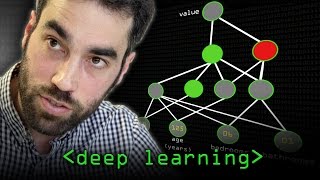
Deep Learning - Computerphile

Deep Learning - Computerphile

Google, Facebook & Amazon all use deep

Deep Learning - Computerphile

Deep Learning - Computerphile

Deep

Sorting Secret - Computerphile

Sorting Secret - Computerphile

Two different sorting

'Forbidden' AI Technique - Computerphile

'Forbidden' AI Technique - Computerphile

The so-called 'Forbidden